Disruptors in Education: Why the Jobs Model Matters for School Innovation
When we think about disruption, we often imagine chaos—a challenge to the rules, a shake-up of something that was working just fine. In the private sector, however, disruption is often a mark of progress. It's what pushes industries forward, creating better products, better systems, and better experiences.
In education, disruption tends to make people nervous. We talk about innovation, but we rarely make room for it. The truth is, without a little disruption, schools can easily slip into stagnation.
Learning from Steve Jobs
In the Harvard Business Review article "Steve Jobs Solved the Innovator's Dilemma," the author explains that Jobs didn't simply improve products—he reimagined them from the ground up. He didn't ask, "How do we make this slightly better?" He asked, "What if we started over?" Jobs understood that innovation often means challenging what already works, not because it's broken, but because it can be better.
That's the mindset education needs. We don't just need new tools; we need new ways of thinking. Our classrooms, curriculum structures, and data systems are often optimized for stability, not creativity. We protect what we've built rather than question how it might evolve.
The Cost of Playing It Safe
In public education, risk aversion is built into the system. We value reliability, consistency, and control—and for good reason. Parents, trustees, and the public expect accountability. But the unintended side effect is a culture that discourages experimentation.
Over the past few years, I've worked on several innovative projects:
- A Digital CoreBoard with multilingual supports for communication in early years classrooms.
- AI-assisted analysis of Acadience reading data to quickly identify learning gaps.
- A pilot project analyzing pencil grips with AI to better understand fine motor development.
- Early Years UFLI web apps, designed to make literacy instruction more interactive.
- A repackaged Indigenous map resource, developed to include authentic voices and current perspectives.
Each project was born from curiosity and a desire to improve learning. But in every case, I encountered resistance. Sometimes I was told, "This isn't your role," or that my work "ruffled feathers." I've even been cautioned—half-jokingly—that my name might be "blacklisted" for pushing too hard.
That's not a reflection of bad people or poor leadership—it's a reflection of culture. A culture where innovation is often only embraced if it's top-down, not grassroots. A culture where good ideas can be seen as threats instead of opportunities.
Why Disruptors Are Crucial
Steve Jobs was what Christensen's Innovator's Dilemma called a "disruptive leader"—someone who challenged existing norms to make room for new growth. In education, our disruptors aren't CEOs or developers—they're teachers, principals, and learning coaches who dare to imagine a better way.
Here's why they matter:
1. Disruptors ask uncomfortable questions.
They're the ones who see gaps in our systems and ask, "Why do we do it this way?"
2. Disruptors bridge art and science.
Like Jobs, they mix creativity with data, empathy with analytics. They use technology, but never at the expense of human connection.
3. Disruptors keep education human.
They remind us that innovation isn't about shiny new tools—it's about deepening learning and equity for all students.
4. Disruptors model courage.
When teachers take risks, they show students that failure is part of growth. That's the foundation of real learning.
Building a Culture That Supports Innovation
If we want to move from compliance to creativity, our boards need to build conditions where innovation can thrive. Here's what that could look like:
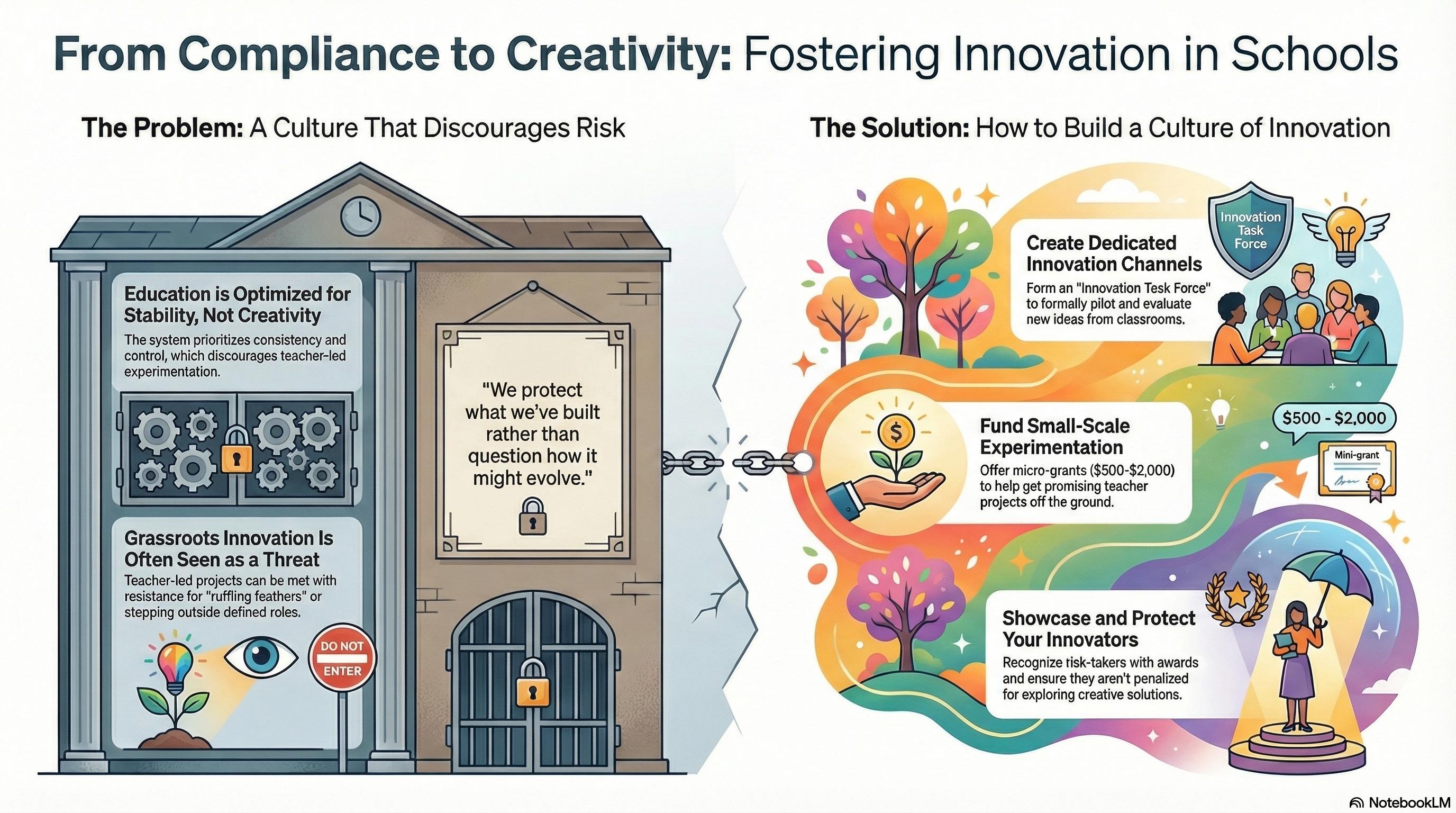
- Create an Innovation Task Force to pilot and evaluate promising ideas from classrooms.
- Offer micro-grants for small-scale experimentation—$500 to $2,000 is often enough to get a good idea off the ground.
- Host "Showcase and Share" events where teachers present projects and lessons learned.
- Recognize innovation through formal acknowledgment or annual awards.
- Protect risk-takers by ensuring teachers aren't penalized for exploring creative solutions that align with student success.
These are small steps, but together they can shift the culture from cautious compliance to confident creativity.
The Real Disruption We Need
Innovation in education doesn't mean throwing out best practices or chasing every new trend. It means being brave enough to ask, "Is this still the best way to serve our students?" and having the space to explore alternatives.
The future belongs to those willing to rethink and rebuild. As educators, we owe it to our students to lead that change—not wait for it.
Disruptors aren't rebels. They're builders. They're the ones who see what's possible when the rest of us have stopped looking.
It's time to make space for them.
Join the Conversation
Are you a disruptor in your classroom? Share your story with the Teach Different community.